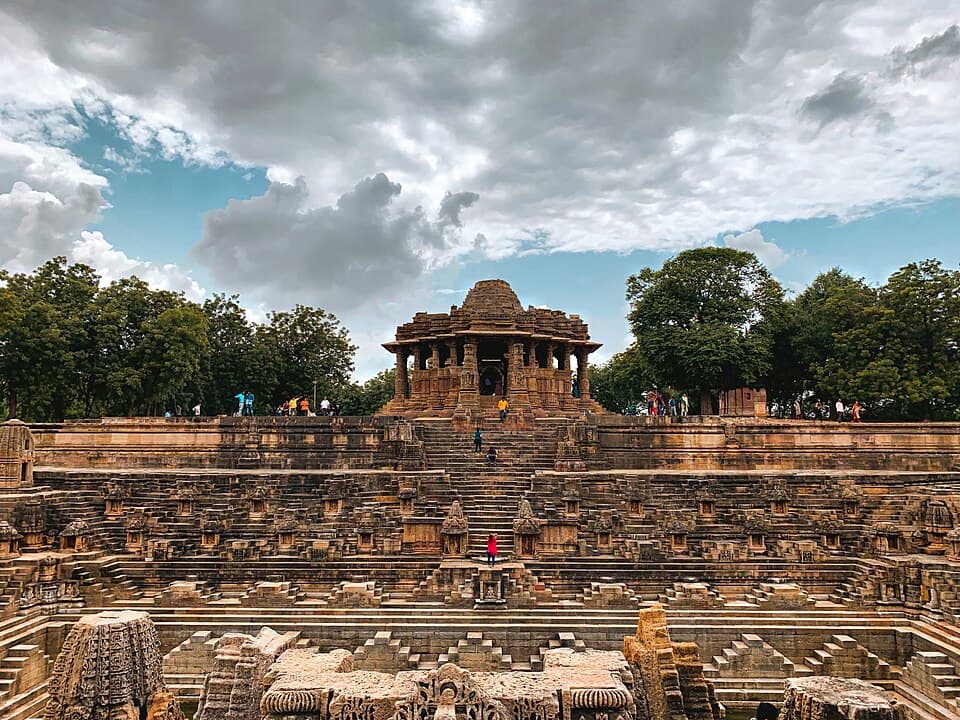
Permission and preservation come first
Check site rules and ask staff about photography, flash, tripods and restricted areas. Do not rub, chalk, wet, trace, clean or make a paper impression of a historic surface yourself. ASI's epigraphy overview describes loss through whitewashing and displacement: better documentation must not create new damage.
Source: ASI Bharat SHRI: About Epigraphy
Capture a three-level photo set
Take an overview showing the object in place, a straight-on view of the whole inscribed face, then overlapping line details. Use natural light when possible. Keep the camera approximately parallel to the surface; avoid a wide-angle close-up that stretches the edges. Do not climb or cross barriers for a better angle.
Check focus before leaving
Zoom into the captured image, not just the live preview. Check small strokes at the center and edges for blur, glare and lost shadows. If permitted and safe, repeat under a different natural-light direction. Keep both versions: a shadow can reveal a groove in one frame and hide it in another.
Keep a usable archive
Save originals before adjusting contrast or perspective. Name derivatives separately and note the edits. Avoid generative fill or AI sharpening as evidence of missing letters. Record site, surface position, capture date, line order and permission notes in a small manifest. Do not post precise locations of vulnerable, unprotected finds publicly.
Field exercise: six files and a manifest
For a long slab, capture one site view, one complete face and four overlapping detail views. Give them a common identifier with suffixes such as context, full, lines-01-03 and lines-03-05. Record the overlap and any obscured text. If photography is prohibited, use the official catalogue or request authorized images rather than taking covert photographs.
Common Mistakes
- Returning with close-ups but no object location.
- Using contrast edits as though they were original evidence.
- Wetting stone or placing a scale against a fragile surface.
Glossary
- Raking light
- Light arriving at a shallow angle, emphasizing relief and surface irregularities.
- Derivative
- An edited copy kept separately from the original file.
- Manifest
- A file list with context and capture notes.
Next Steps
- Prepare an image manifest and uncertain-letter list before requesting a reading.
- Share high-resolution originals privately with an appropriate museum, archaeology office or epigraphist.
Primary References
- ASI Bharat SHRI: About Epigraphy
Institutional introduction to scripts, languages, preservation and inscription publications; not an edition of your stone.