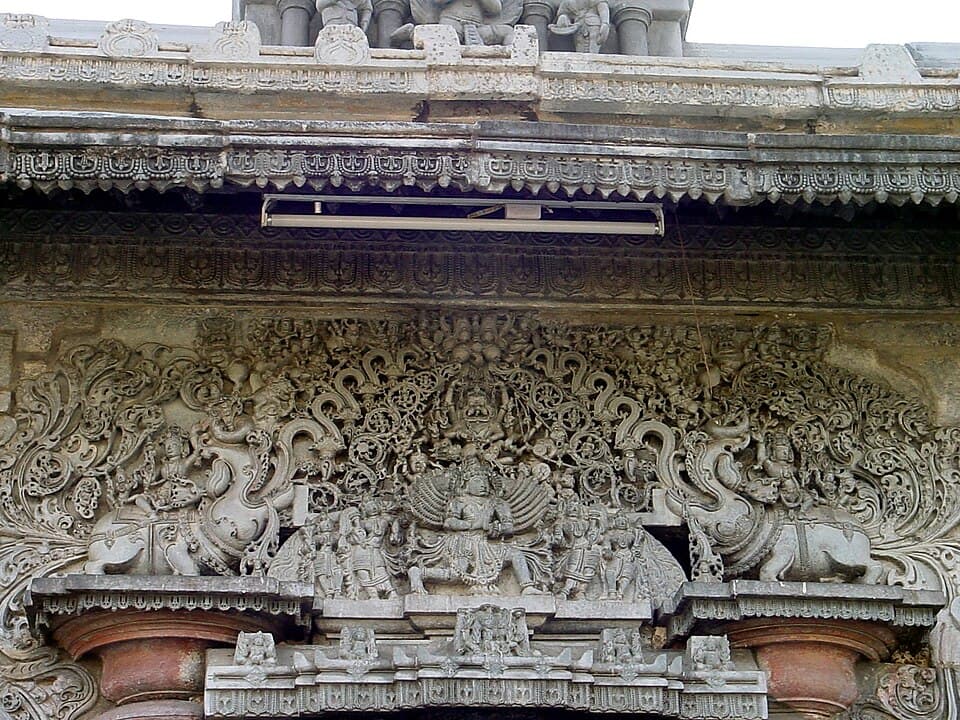
Describe before identifying
Record posture, number of arms, held objects, gestures, accompanying figures and placement. Be explicit about missing hands or repaired parts. A lotus or an animal alone rarely provides a secure identification: compare a cluster of attributes and the setting rather than relying on one symbol.
Use a museum object as a controlled example
The Met's Nataraja, accession 1987.80.1, is catalogued as a late-11th-century Tamil Nadu copper-alloy sculpture. Its record identifies the drum, fire, fear-allaying gesture and figure beneath the foot. These attributes work together in that object's interpretation; they are not a rule that every dancing figure is Shiva.
Source: The Met: Shiva as Lord of Dance (Nataraja), 1987.80.1
Placement changes the question
A doorway guardian, narrative panel, independent shrine image and decorative frieze have different roles. Include enough of the surrounding wall to show where a figure belongs. Record what is physically present rather than assuming every animal is a vahana or every raised hand has the same mudra.
Keep style distinct from identity
Knowing the likely deity does not establish a date, workshop or dynasty. A familiar iconographic form can be repeated across periods. Treat comparisons as questions: which attributes match, what differs, and what does the catalogue actually say? Avoid dating an undocumented carving from a single resemblance.
Field exercise: one missing attribute
If a sculpture has four arms but two hands are broken, inventory only the surviving objects. Use “possible identification” until a label, inscription or specialist comparison resolves it. Do not let an AI description restore the lost attributes in your evidence record.
Common Mistakes
- Identifying a deity from a lotus alone.
- Calling all animals beside figures their vehicles.
- Inferring dynasty from deity identity.
Glossary
- Mudra
- A gesture with context-dependent significance.
- Vahana
- A deity's vehicle or mount, when the identification is supported.
- Attribute
- An object or feature used in identifying a figure.
Next Steps
- Compare the Met object record with its image and list the paired attributes.
- Make an observation sheet for one carving without assigning a date.
Primary References
- The Met: Shiva as Lord of Dance (Nataraja), 1987.80.1
Object-specific catalogue description, dating and interpretation; compare its own photograph, not an unrelated temple carving.